
Nurmo cemetery
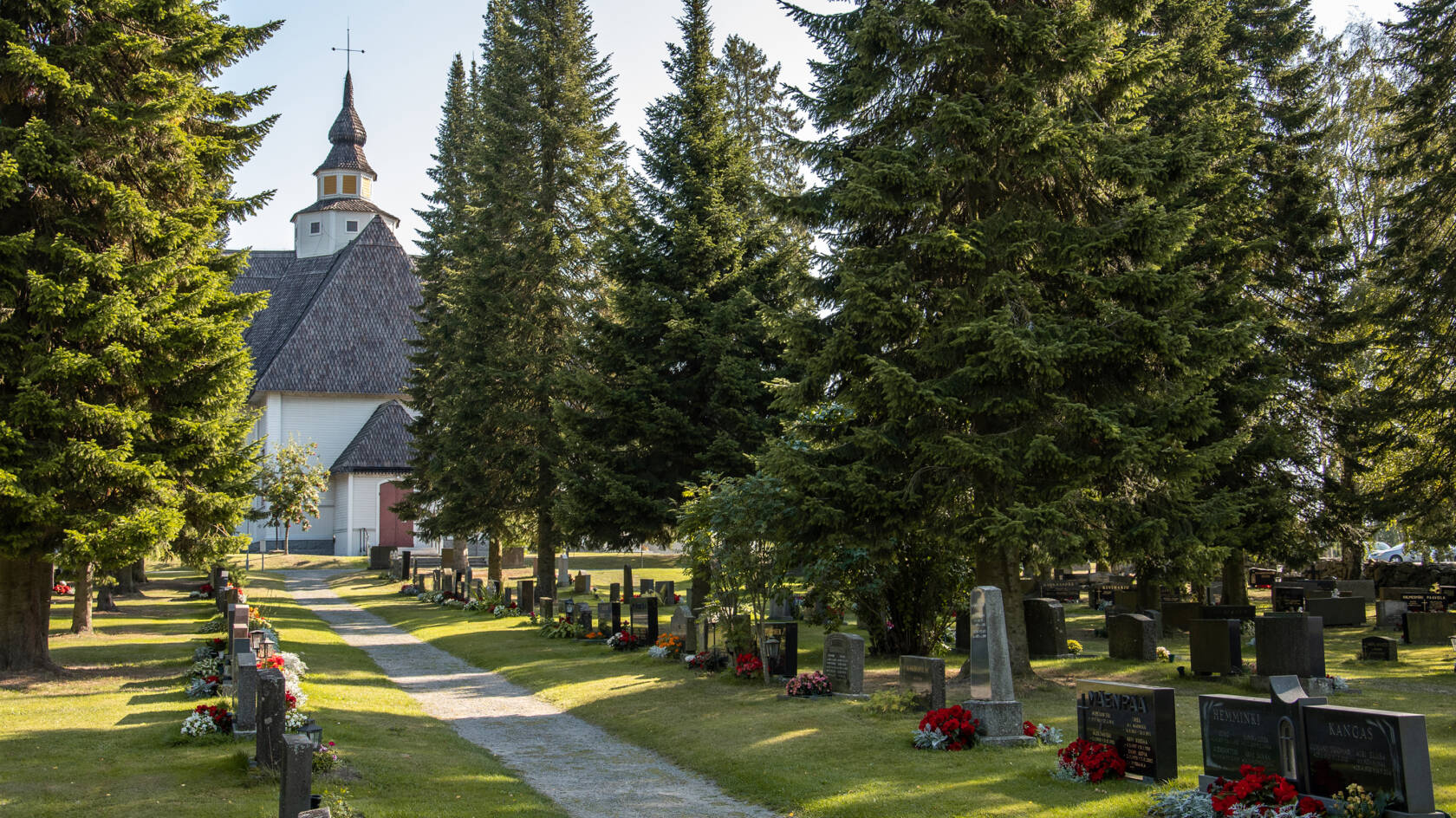
Nurmonjoentie 17, 60550 Nurmo
Open 6:00–23:00, all day on public holidays.
Accessibility
- Accessible WC
- Parking space for people with reduced mobility
About the cemetery
Nurmo cemetery
During the Early Middle Ages, Nurmo was part of a bigger parish municipality. In the year 1581, Lapua was granted the rights of a parish, and Nurmo joined Lapua as a village of Ylinurmo. In 1766 Nurmo and Seinäjoki formed a chapel community, and in 1816 a chapel parish. Seinäjoki became a chapel parish of Ilmajoki in 1863, and Nurmo started its life as an independent parish in 1879. During the parish merging of 2009, Nurmo became one of the chapel parishes of the Seinäjoki parish.
Nurmo received its own preaching house, which could fit between 150 and 200 people, as early as 1727. The preaching house was built without permission, and, in opposition to that, for decades it did not receive an official consecration by the mother church of Lapua. The deceased from Nurmo still had to be brought to Lapua to be buried in a churchyard. Temporary burials took place in the early 18th century. Near the preaching house there was an enclosed graveyard where the first burials took place in 1767; before that the deceased were buried in Lapua.
Only in 1765 did the king answer the plea from the people of Nurmo to form their own church congregation, and the following year, the preaching house was inaugurated. It was a long church that went from east to west, with a rather narrow tower at its eastern end. This preaching house did not get a priest of its own.
In a few decades, the preaching hut revealed itself to be too small. After an inspection that took place in 1768, the church tower on the western end of the building was declared dangerously unstable. The bell tower was built next to the preaching house in the year 1770. Despite the cathedral chapter’s opposition, the construction of the new church began without a permit under the lead of Antti Hakola, from Alahärmä. In this he was helped by his son, Kaapo Hakola. Antti Hakola died in April 1778, and Kaapo Hakola finished the work that his father had started.
The first cemetery
A small cemetery was built next to the preaching house. The cemetery was consecrated in 1766 by the vicar of Lapua, Isak Lithovius, apparently with the church. The first cemetery covered only the area east of the church, from the current chapel of rest to the bell tower. The first cemetery was unfenced and covered an area of roughly 32 acres. That little cemetery was enough for the people of Nurmo for 40 years.
Over the course of the years, the cemetery has been expanded multiple times. The expansions have been generally small, only as much as a few dozen acres. The land was acquired through purchase, donation, and compulsory acquisition, generally from the Luon-Sandelin farm.
Expansions were made to the cemetery in 1807, 1841, 1891, 1920, 1943, 1947, 1956, 1972, and the 1980s, and the additional lot of land has already been acquired for the expansion of the 2020s.
The gravedigger
Years of famine took a heavy toll on the population of Nurmo—241 people died from hunger-related diseases between 1867 and 1868; that is close to 9% of the population. The burials during the year of the great famine increased so much, that the chapel parish decided to hire a gravedigger. Before that, the people of Nurmo had to dig the graves for their relatives themselves. Only the graves for the poor and the afflicted, located on the northern edge, were dug by the parish. However, this was also a possibility after the gravedigger was hired.
In 1888 the choice to move the cemetery to a new destination was also contemplated. The reason was a decree from the imperial senate of the year 1879, which stated that the new cemeteries had to be built far from the residential areas for reasons of public health. A commission was established in Nurmo in the year 1888 to research a fitting new place for the cemetery. The imperial senate also gave the parish permission to use the already existing place as a graveyard, and this allowed the parish to expand it.
Heroes’ cemetery area
In 1918, the oldest section of the cemetery was put back into use. There was established a heroes’ cemetery for the war heroes of Nurmo fallen in the Finnish Civil War. A memorial for the fallen heroes was built by the Granit Hangon from red granite, and it was revealed on 20/08/1921.
The Winter and Continuation War brought activities at the cemetery to a halt. At the start of the 1940s, the most important issues were the blessing of the fallen heroes and the expansion of the heroes’ cemetery. The parish took care of the burial of the fallen heroes, buying the burial lots, and blessing the remains left on the field. In 1942, the parish began to consider the acquisition of a statue to honor the fallen heroes, and then it was decided to turn to Ilmari Wirkkala, who designed the Finnish Civil War Memorial.
In 1943, a committee consisting of the relatives of the fallen heroes was established for the purpose of acquiring the heroes’ cemetery and the heroes’ statue. The heroes’ cemetery was expanded in the direction of the sacristy. At first, wooden crosses painted white were placed on the heroes’ graves. In 1949, it was decided to commission Kalervo Kallio’s sculpture “Siunaus ja rauha” as a monument to the heroes.
After the acquisition of the new heroes’ statue, the previous location had to be slightly adjusted, as the space at the heroes’ cemetery was too few. The Finnish Civil War heroes’ statue was partially dismantled. For example, the granite balls were detached from the statue and placed at the corners of the curbstones of the heroes’ cemetery. The changes to the former memorial apparently led to complaints among residents. There were talks, for example, of desecrating the tomb, and the matter was even brought before the diocesan chapter.
Toward the end of the Continuation War, the question arose regarding the bodies of the reds executed in 1918 at the nearby Paukaneva, which had been buried in two unmarked mass graves on the same bog. In July 1944, the Vaasa Provincial Administration was asked whether these 1918 victims could be buried in the Nurmo cemetery. The deceased were laid to rest in Nurmo on November 19, 1944, following a religious service. Their graves are located in Section IV, roughly halfway through the cemetery. The graves are marked by a memorial stone carved from red granite, on which the number of unidentified deceased is indicated by crosses.
Cemetery Maintenance
As late as the 1700s and 1800s, cemeteries were not particularly well maintained. In the 1900s, attention began to be paid to the aesthetic value of cemeteries. As early as the 1800s, ornamental trees were planted on church grounds—such as willows in the churchyard in Nurmo in the 1840s and birches and spruces in the expansion area in the 1890s—but generally, cemeteries were maintained mainly through volunteer labor, if at all.
Over the course of the 20th century, however, cemeteries began to be maintained in an increasingly uniform manner. In Nurmo, for example, this is evident in the replacement of the old cemetery chapel with a new one, a decision that was justified specifically based on aesthetic considerations. The activities of the gravediggers working at the cemetery also began to be defined more precisely than before.
In 1930, a committee was established in Nurmo with the purpose of drafting, based on the model bylaws of the cathedral chapter, bylaws governing the maintenance of the cemetery and the duties of the gravedigger.
In the 1930s, the church administration organ was established, with responsibility for overseeing the cemetery among its duties. The church administration held its first meeting concerning the cemetery in the year 1935 and took it upon itself to ameliorate the cemetery’s exterior. In the year 1938, the Finnish Home Gardening Association was invited to oversee the landscaping work in the church garden.
The mapping and planning of the garden were largely made together with the expansions. In 1943, drawings were commissioned showing the locations of the graves and walkways on a small additional plot of land acquired in the northern part of the cemetery.
The drawings were commissioned between the 1930s and 1940s by Ilmari Wrkkala, from Helsinki. The memorial for the fallen heroes of the Finnish Civil War was mentioned as having been designed by Ilmari Wirkkala. Wirkkala worked as the artistic director of Granit Oy. Wirkkala (1890–1973), who was born in Kaustinen, is known as Finland’s first cemetery architect. He also designed grave monuments and heroes’ cemeteries and painted altarpieces.
The cemetery was surveyed several more times. A thorough survey was conducted in 2010, and the maps were digitized in 2011.
Notable Graves
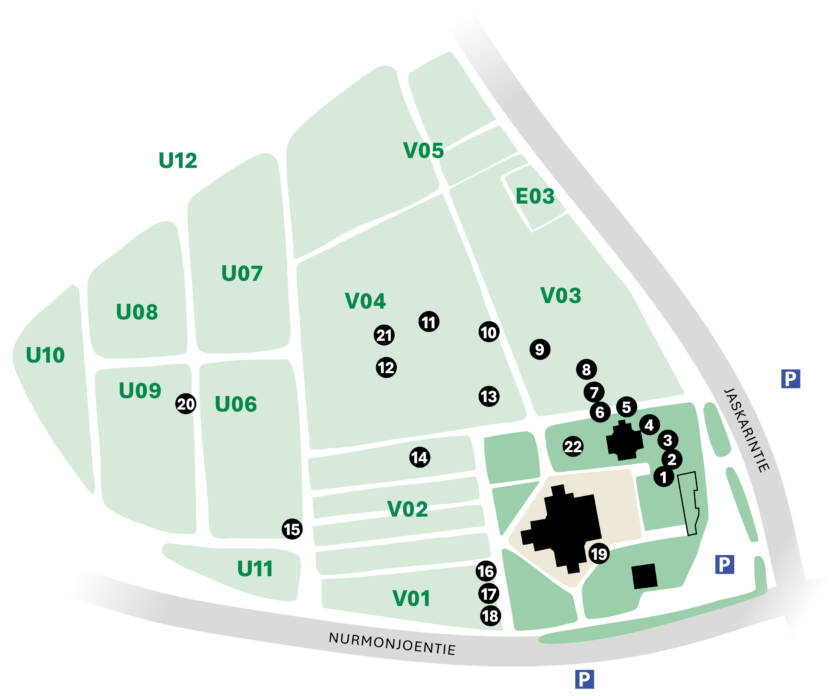
1. The Tallroth/Honkajuuri Family Grave
In this grave lie: Nurmo’s first pastor, Reverend Albert Emil Tallroth (1840–1890), his wife, Mrs. Alma Cecilia Tallroth (née Forsman), and their children (?) Anna Sofia, Rudolf Mikael, and Gunnar Rudolf Mikko Tallroth, Chief of Police in Vaasa; Mauri Honkajuuri, President of Kansallis-Osake-Pankki and Master of Laws; Helmi Honkajuuri (née Tähtinen); Helmi Helena (Leena) Honkajuuri, Mikko Paavo Honkajuuri, Hilkka Annikki Honkajuuri (née Hirvonen), and Maire Ilona Honkajuuri.
Mauri Honkajuuri applied for the burial plot in 1936, and it was granted, in part due to the achievements of his father, Nurmo’s first pastor, and in part due to Mauri Honkajuuri’s own generous donation to the municipality of Nurmo. It was even provided free of charge.
Albert Emil Tallroth arrived in Nurmo as a chaplain in a time when rascals with knives were at their worst. In the time of his predecessor, Henrik Linderoos (1848-1868), the church discipline had loosened. Tallroth first served as Linderoos’s assistant, and after Linderoos was dismissed, Tallroth, as the sole applicant, was appointed to the position in 1872.
Tallroth restored the church discipline and took a hard line against those who violated it, as well as against all forms of crime and disorder. Tallroth was also elected the first pastor of the parish, which was founded in 1882. Tallroth was even called the “Bishop of Nurmo.”
The Tallroth/Honkajuuri family grave monument was designed by artist Matti Visanti. It was modelled after the “Ykskorva miller,” whose last name was Jaskari, and his wife, who lived next door to the parsonage.
2. Vicar Viljo Adolf Elonheimo (1903–1974)
In the same grave rests also his wife, Else Margarita o.s. Snellman (1911) Viljo Elonheimo served as vicar of Nurmo for almost 30 years, from 1940 to 1969. In addition to the names and dates, the stone bears the inscription “I know that my Redeemer lives”. His wife, Margareta Elonheimo, ran the vicarage office located in the rectory.
3. Ernst Aksel Lagerstedt (1894–1969)
Nail manufacturer in Veneskoski.
4. Nikolai Ernst Alexander Bähr (1800–1857)
A master cooper born in Copenhagen who worked at the Östermyra ironworks in Törnävä. Before the church in Törnävä was built, workers from the Östermyra ironworks were also buried in Nurmo.
5. Aatos Yli-Jaskari (before Jaskari, 1904–1962)
Aatos Yli-Jaskari won an Olympic bronze medal in freestyle wrestling in the 56-kilo category at the 1932 Games in Los Angeles. He was Finnish champion in 1931, 1935 and 1937, and also won four silver and one bronze medals at the Finnish Championships.
6. Mikko Jaskari (1866–1936)
Mikko Jaskari served as the parish treasurer. Jaskari was described as “the embodiment of a South Ostrobothnian farmer endowed with the finest qualities”. Jaskari had made a name for himself in local community life in Nurmo; he served as a lay member of the church council and was one of the founding members and a board member of the Karhumäki Revivalist Folk High School. Jaskari designed the new chapel, which was completed in 1928.
7. Juho Kesälahti (before Juhana Hellen, 1871–1941)
Cantor-organist. He was described as ”musically relatively talented”.
8. Vicar Johannes Zachris Hartman (1848–1908)
The vicar Johannes Zachris Hartman became vicar of Nurmo in 1899 and served as such until the year 1908.
Hartman is remembered as a hot-tempered and even irascible man. He fiercely opposed the Socialists, looked down on the revivalist movement, and ran a strict confirmation school – so strict that many would rather leave their child in Lapua, to the Wilhelmi Malmivaara confirmation school. It is even said that Hartman once came to a fistfight with another parishioner inside the rectory.
Despite his fiery temperament, Hartman is said to have been a brilliant preacher. A memorial to him is an obelisk on which, in addition to the dates, there is a reference to the Old Testament: “Isaiah 54:10”.
9. Hermanni Pihlajamäki (1903–1982)
Hermanni Pihlajamäki was, together with his cousin Kustaa, one of the best-known members of the Pihlajamäki family of wrestlers from Nurmo. Hermanni won gold in the Los Angeles Olympics of 1932. In addition, during his career he won six Finnish championships, three European Championship medals (gold in 1931, two silver in 1935) and an Olympic bronze in Berlin in 1936. In his civilian life, Pihlajamäki was a police officer. His wife, Laina Sofia (née Kujala) (1900–1988), is buried in the same grave.
10. Gustaf Alexander Wasastjerna (1859–1943)
Gustaf Alexander Wasastjerna bought the Louko manor located near the church in the year 1881 and served as its master until his death. Members of the noble Wasastjerna family had lived on the estate even before, when his father, Gustaf August Wasastjerna, the owner of Östermyra, purchased part of Ala-Louo in 1862 and part of Yli-Louo in 1866. In 1859, a residential building was brought from Jouppila in Seinäjoki to the former Ala-Louo estate; this was subsequently renovated in 1895 according to plans drawn up by the architect Josef Stenbäck. Gustaf August Wasastjerna was forced to sell the estate at a compulsory auction as early as 1870 to his cousin Alfred Wasastjerna. Gustaf Wasastjerna’s son Alexander bought the manor from his father’s cousin in 1881.
Wasastjerna significantly expanded Louko’s farmland and dairy herd. During his lifetime, Alexander Wasastjerna held many positions of trust in Nurmo, such as chair of the municipal council. In 1918, he was awarded the title of Agricultural Counsellor. The Sandelin family grave next to it refers to the farm’s current owners, who are descendants of Wasastjerna.
11. Aukusti (Kyösti) Luukko (1903–1970)
Aukusti Luukko also belongs to the wrestling champions of Nurmo. Luukko won silver in the Los Angeles Olympics of the 1932. He also won a bronze medal at the European Championships in Budapest in 1931, Finnish Championship gold in freestyle wrestling in 1931–33, 1936, 1935 and 1937–38, and Finnish Championship gold in Greco-Roman wrestling in 1928 and 1933.
12. Salomon Efraim Kuusela (1875–1957)
Salomon Efraim Kuusela was the last usher in the Granskog family. Salomon Kuusela served as sexton for around 30 years, from 1925 to 1954. His father, Salomon Granskog, served for as many as 60 years. Earlier members of the family had also served in the Nurmo parish, for example as sextons, dating back as far as the 18th century.
13. Kustaa and Hildi Lankari (1883–1960, 1899–1962)
The first tenants of the Lankari estate in the year 1817 adopted the name Langard for the estate. The following owners adapted the name to Lankari in order to make it more Finnish. In the year 182 begins the Lankari family tenure.
Over the course of 135 years, three Kustaa have lived in the Lankari estate. During the time of the second Kustaa, the lifestyle at Lankari Farm strongly adhered to the Revivalist movement. At that time, Nurmo was one of the Revivalist congregations in Ostrobothnia.
Kustaa Kustaanpoika Lankari was the last owner of the estate. He married Hildi Maria Salminen, who was originally from Askola, in 1941 at the age of 58. The traditions of the Heränne movement, including its societies, continued at the farm under the new owner. Hildi and Kustaa Lankari had no children and decided to donate their remaining estate to a charitable cause.
In 1958, they drew up a will naming the Herättäjä Association as the beneficiary, the purpose of which was to promote work supporting the Revivalist movement by ensuring that the said property was used for the recreation of Revivalist ministers or in some other suitable manner. However, within the Herättäjä Association, it was felt that the planned holiday destination would not be sufficiently utilised in the future, and work began on developing a foundation model. The foundation was established in 1965 and leased the site to the Nurmo parish to serve as a camping centre. Today, Lankari is a modern camping centre in use all year round.
14. Paavo Salo (1931–2014)
Paavo Salo, vicar. Priest in Nurmo from 1960 to 1993.
15. Erkki Penttilä (1932–2005)
Erkki Penttilä won an Olympic bronze medal in wrestling in 1956.
16. Kustaa Pihlajamäki (1902–1944)
Kustaa Pihlajamäki is the most successful Finnish wrestler of all time and a two-time Olympic champion: in Paris in 1924 and in Berlin in 1936. Pihlajamäki won an Olympic silver medal in Amsterdam in 1928. He also won six European Championships in Greco-Roman wrestling (1930, 1933, 1934, 1937, 1938 and 1939), two in freestyle wrestling (1934 and 1935), and two silver European medals in freestyle wrestling (1931 and 1937).
In his regular life Pihlajamäki worked as a police officer at the Helsinki police department and as such he was an institution. Just mentioning if name would get criminals to freeze.
17. Niilo Tikkanen (1906–1939)
Staff sergeant Niilo Tikkanen, Nurmo’s first fallen hero.
18. Aukusti Ripsaluoma (1884–1947)
Aukusti Ripsaluoma served as director of the Paukkula Finnish Youth College from 1923 onwards and had a major influence on the development of the youth association movement. Liisa Ripsaluoma, Marjatta Hosia (née Ripsaluoma) and Sirkka-Liisa Ripsaluoma are buried in the same grave.
19. Pastori David Arelius (1729–1806)
Reverend David Arelius was the first vicar of the Nurmo chapel parish, and he served in this post for 40 years, from 1766 to 1806. Arelius was born in Aronkylä, Kauhajoki, and was therefore a native of the region. His memorial stone was erected in 1928, apparently at his grave site next to the church. The grave is bordered by kerbstones, the inner space between which is filled with fine gravel. The following text is engraved on the memorial stone: “Here lies Pastor David Arelius 30 December 1729-7 November 1806, having served the Nurmo parish as its first vicar for 40 years. This statue was erected in 1928 to preserve his memory. Hebrews 13:7.”
Memorials
Graves and memorials of those who died for their beliefs
The memorial and common grave for those who died for their beliefs are situated in the middle of Section IV. The remains of those buried here were transferred in the autumn of 1944 to Nurmo Cemetery from Paukaneva, where they had been buried in 1918 in two unmarked mass graves. The memorial consists of a horizontal slab of red granite. The stone bears 21 silver crosses arranged in two rows, each representing one of the unidentified deceased buried there. The stone also bears the inscription: “Those who gave their lives for their beliefs”.
Engraved on the sides of the stone are a hand holding a torch (on the left-hand side) and a radiant sun (on the right-hand side). The grave is maintained by the parish.
Heroes’ grave and statues
The Heroes’ cemetery is situated to the east of the church, on the edge of the cemetery. It was established in 1918 for the fallen white heroes from Nurmo who fought in the Finnish Civil War. The heroes’ graves are arranged in a square formation between the heroes’ statue and the sandy path leading towards the sacristy. The heroes’ graves area is covered in grass and surrounded by kerbstones. Uniform bronze crosses have been erected at the heroes’ graves.
The stone of the memorial for the fallen heroes of the Finnish Civil War is wide and low, composed of rectangular red granite upright stones both high and low. The central, low stone carries the inscription: “For their homeland, for their fatherland / these heroes marched to their deaths. This mound is now the heroes’ crown: visit their grave and pray in silence”.
The memorial for the fallen heroes of the Finnish Civil War was moved and slightly modified when, after the Second World War, a statue was commissioned from the sculptor Kalervo Kallio. The statue is made of bronze, and depicts an angel descended from heaven to bless the heroes’ cemetery. The angel stands on a large, cube-shaped stone plinth, on the front of which are engraved the years 1918, 1939–1940 and 1941–1944. On the left-hand side is engraved the text: “The place where you stand is holy ground. Exodus 3:5”.
A special memorial for the men in the front-line has been erected on the strip of grass between the heroes’ cemetery and the church tower. Beneath it lies a mass grave where veterans of the Winter War and Continuation War – mostly lone front-line soldiers – have been and continue to be buried. The memorial was erected in 1965, on 5 March, the anniversary of the Battle of Äyräpää. From the start, the parish decided that the grave would be maintained by and large on behalf of the parish and that the parish would also cover the cost of the inscriptions. The burial plot was provided free of charge, but a burial fee was charged.
The memorial to the soldiers whose bodies remained in Karelia is situated next to the main walkway. The memorial consists of a plinth, a cube-shaped stone resting on top of it, and a natural stone placed moreover. Inscribed on the side of the cube in block letters are the words: “To those who remained in Karelia, there I carry my longing”.
A memorial to the victims of the famine years stands south of the church, near the stone fence. The memorial consists of a natural stone, the front of which has been polished to form a small square, as a base for the inscription. The text is painted in black letters: “In memory of all the heroes who died in the great famine of the 1860s – give us this day our daily bread”. The memorial was erected in the year 1967. The stone is originally from the Yli-Luoko plinth, as the house served the poor during the famine years.
The memorial to those buried elsewhere stands beneath the hill in the churchyard, facing north, that is, towards the cemetery. The memorial consists of a large boulder to which a plaque bearing the following inscription in black letters has been affixed: “Lord, we remember our loved ones who have passed away in your presence”.
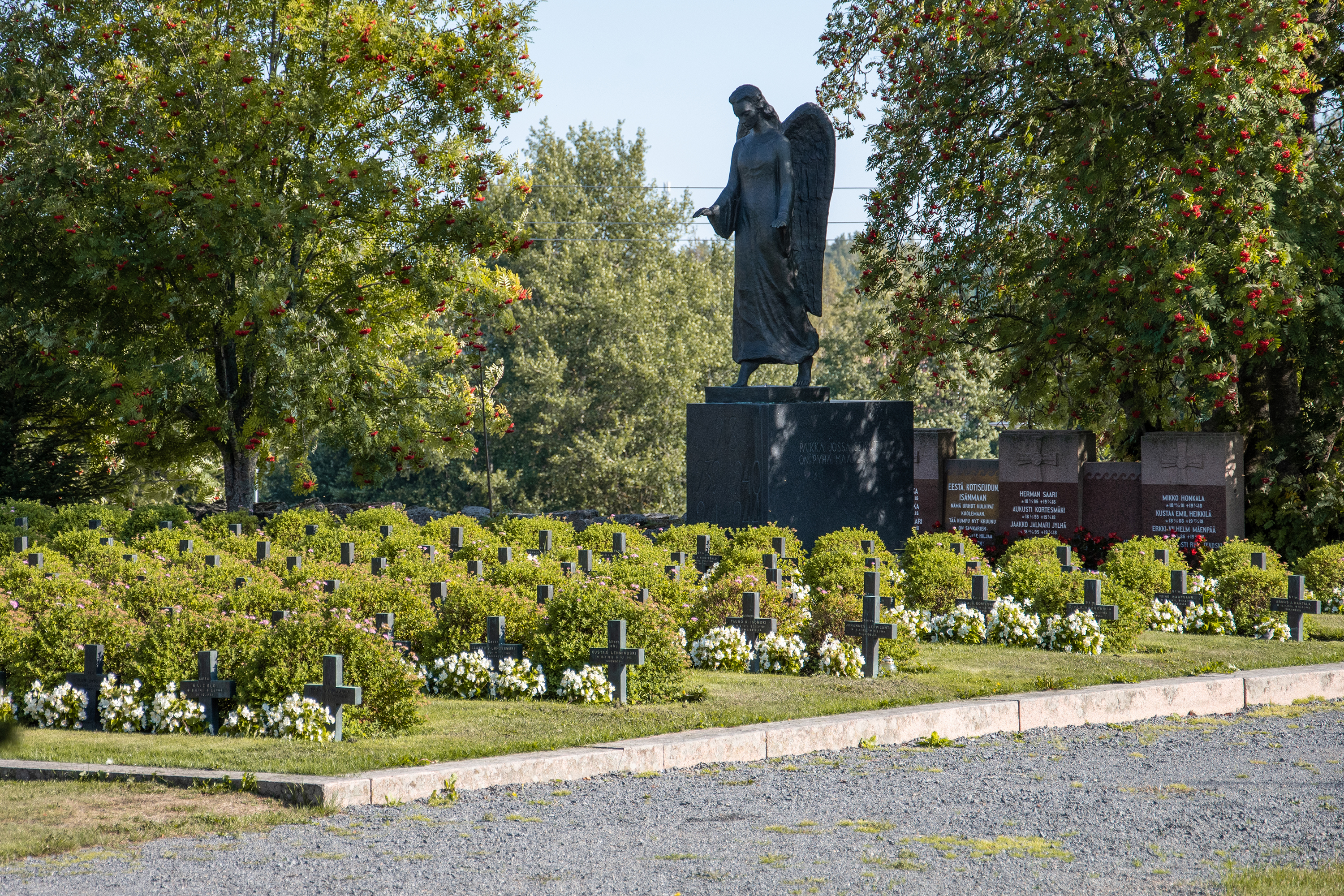 Nurmo heroes’ cemetery, heroes’ statue, memorial
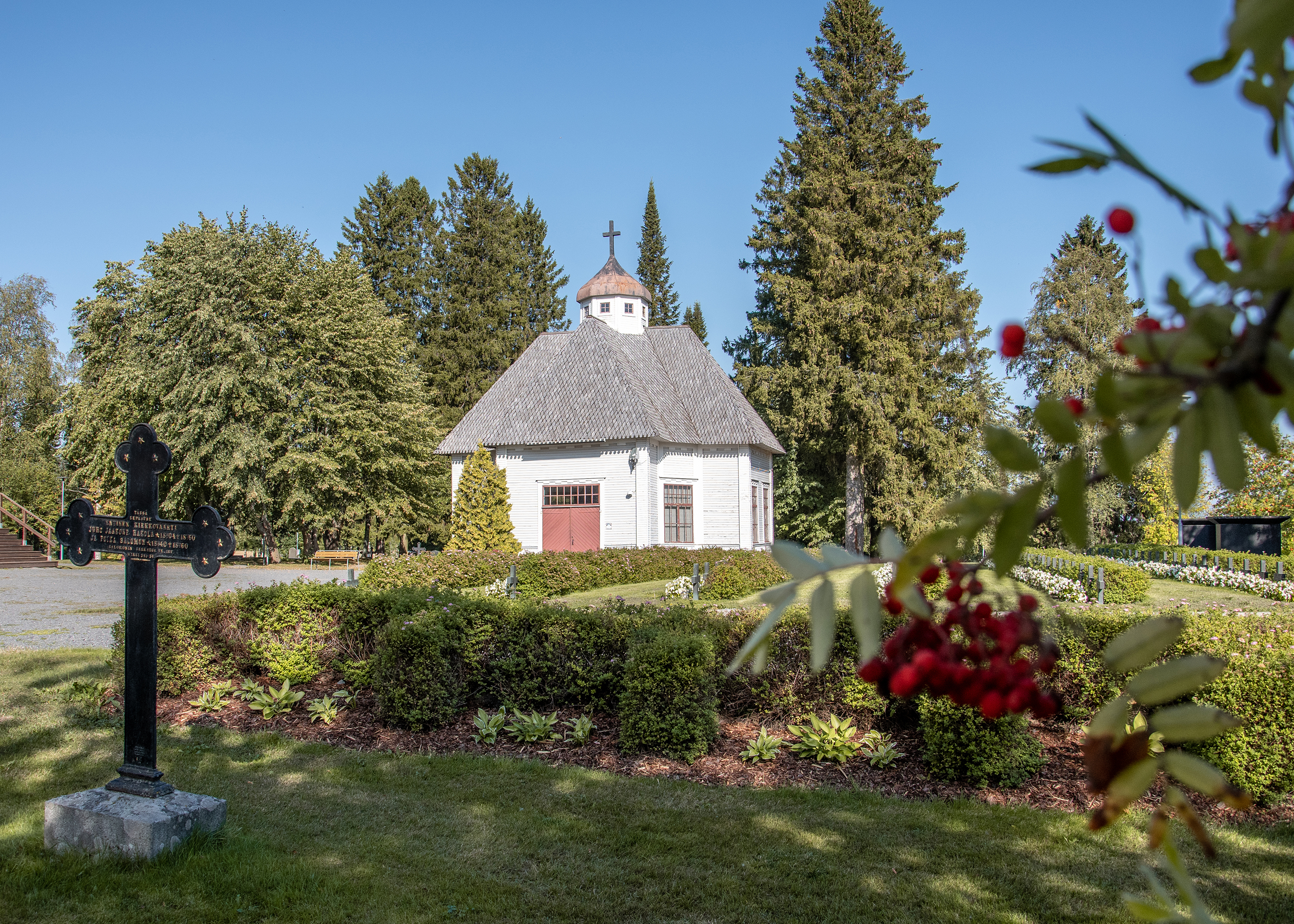 Nurmo church, heroes’ cemetery
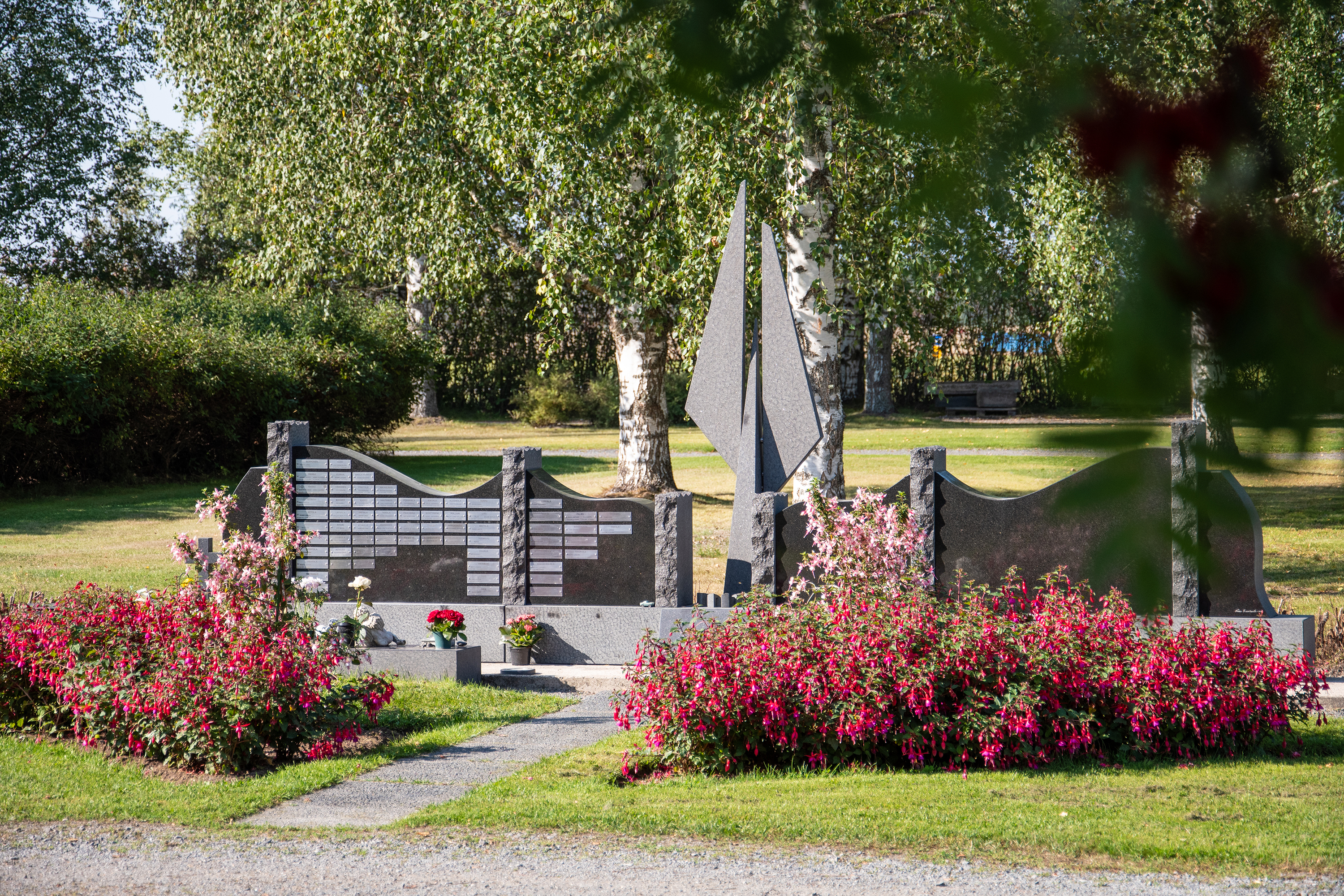 Nurmo cemetery, memorial grove
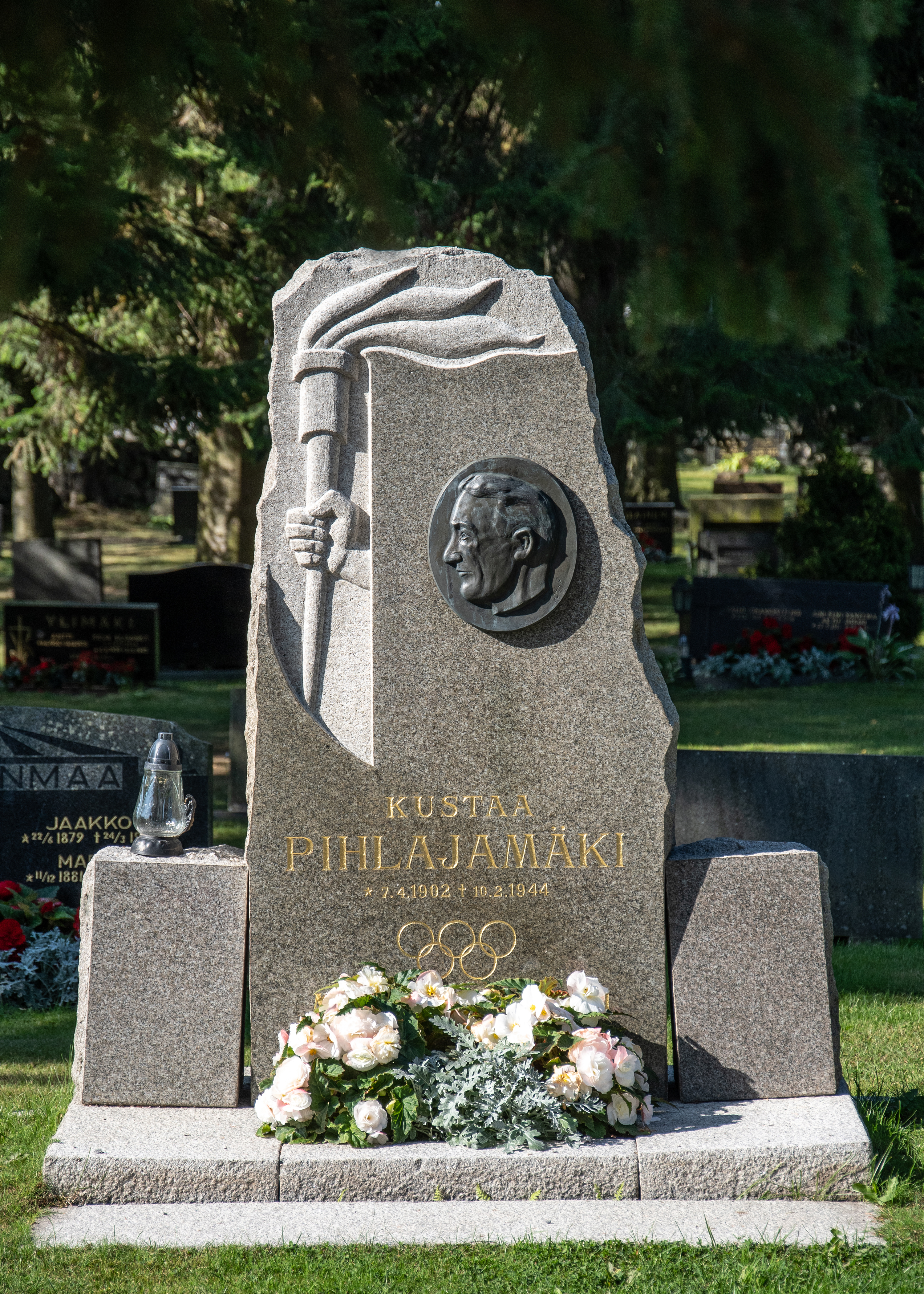 Kustaa Pihlajamäen, gravestone
The Hautahaku.fi service helps you find the graves of your loved ones
Searches are carried out using the deceased’s surname and can be filtered by year of birth and death or by cemetery. The map service included in the service shows the location of the grave within the cemetery. The grave search can be used on a web browser or a mobile device.