Peräseinäjoki cemetery
Kirkkotie 32, 61100 Peräseinäjoki
Open 6:00–23:00, all day on public holidays.
Accessibility
- Parking space for people with reduced mobility
About the cemetery
Peräseinäjoki cemetery
In the 18th century, the Ilmajoki mother parish comprised the residents of the village of Peräseinäjoki (Yläseinäjoki), at the time in the Ilmajoki municipality, as well as those of Kurjenkylä, in the Virrat municipality. The journey to the mother church of Ilmajoki and to the cemetery was long, especially from the southern parts of the municipality, and due to the wideness of the wetlands, contacts were really difficult, particularly during summer and frost heaves. Transporting the deceased to consecrated church grounds proved difficult.
The temporary graves at Kettukanka and Ruissaari
According to tradition, the deceased were buried here during summer in temporary graves, and only later moved to the graveyard of Ilmajoki. One of these temporary grave sites is located in Kettukangas, in the Sammatti municipality. This is where the deceased from Kurjenkylä, in the Virrat municipality, were buried.
Another temporary resting ground for the deceased from Peräseinäjoki has traditionally been Ruissaari, a small lake island in Seinäjoki, in the Ilmajoki’s village of Rengonkylä. The original name for Ruissaari was Ruumissaari (the island of the bodies). The bodies were carried from the temporary graves to Ilmajoki during Autumn, after farm work, along the river or on a sledge, during winter.
Our own cemetery
The vicar of Ilmajoki understood well the difficulties of travelling, and in 1747 he encouraged “the inhabitants of remote villages to think about their spiritual wellbeing and build a preaching house to bury their dead on consecrated ground”. After over 20 years of waiting, the people of Peräseinäjoki received, in the year 1777, the final permission to build a preaching house from a cathedral chapel, and to establish a cemetery on the field belonging to the Kärki estate, near the present-day church. The area was fenced and consecrated. The place was named Kotomäki. The preaching house was completed in 1784. In the year 1798, Peräseinäjoki was granted the rights to be a chapel parish and the permission to have its own chaplain. At the same time, the preaching house was upgraded to a chapel church and a sacristy was added.
Grave digging
For use of the cemetery, a bell and soil fee was collected. The family of the deceased took care of the digging, covering and maintenance of the grave until 1881, when a part-time gravedigger was hired. However, the responsibility for covering the grave was still on the family.
Arrangements for the burial
The original cemetery was situated in the immediate vicinity of the chapel church, and the deceased were buried in an undefined arrangement. On the initiative of the prefect, a separate cemetery was established at the beginning of the 19th century on parish land, on the north side of the church, near the current heroes’ cemetery. Burial without authorisation was prohibited, and directions were given to bury the bodies in organised rows, at least 180 cm underground. The partially collapsed winter graves near the church needed to be covered with a proper lid. When the cemetery got too crowded, it had to be expanded, both in the 1850s and 1870s.
The new church
The current church in Peräseinäjoki is the second to be built on the site. It was completed in 1892, designed by the architect Ivar Aminoff from Vaasa. The church was commissioned by Juho Karjanlahti. The church is a cruciform church with three galleries; stylistically, it represents a kind of transitional or ‘carpenter’s’ style and also displays Neo-Gothic influences.
The construction of the new church reduced the area of the cemetery, as the new church was considerably larger than its predecessor. Some graves were left beneath the church at that time, although some of the deceased were also reinterred elsewhere whilst the church was being built. This marked the end of the old cemetery’s active use. The construction of a new road leading to the town centre, right next to the church, has also reduced the size of the cemetery.
The new cemetery
The church graveyard started to become tighter and tighter at the end of the 19th century. The vicar of Ilmajoki brought back the long-discarded thought of finding a new cemetery for the chapel parish. Already the following year, for 400 marks the parish claimed an area of two hectares from the householder Matti Kärki. The area was in Kupilanmäki, on the south side of the Alavus road, just over half a kilometre from the church. After the soil works, the new cemetery became operational in 1890. It was consecrated the same year. According to local tradition, the parishioners were not particularly keen to start using the new cemetery at first; even after it was completed, they still preferred to be buried in the old cemetery in the churchyard, where their ancestors had been laid to rest. The first person to be buried in the new cemetery was Sanna Kanto, who died at age 4 and was buried in the spring of 1892. This marked the beginning of the use of the new cemetery.
The expansion of the cemetery
The cemetery started to fill up, and in the 1960s it became necessary to find an extension area. The parish owned a plot of land north of the highway that could fit the purpose, near the current mortuary. However, the soil was regarded as too stony to be considered an option for the expansion. In 1972, the parish made the decision to buy an area of around 1,5 hectars near the cemetery, on the eastern side, from the heirs of the Holmi family. The foundation work started right away, and Bishop Yrjö Sariola consecrated the new section in 1976.
This “new section” is also gradually filling up. The next expansion area is planned next to the “old section,” to its south, where approximately 1 hectare of land has been acquired from the Liikala estate for this expansion.
Graves of notable people from Seinäjoki
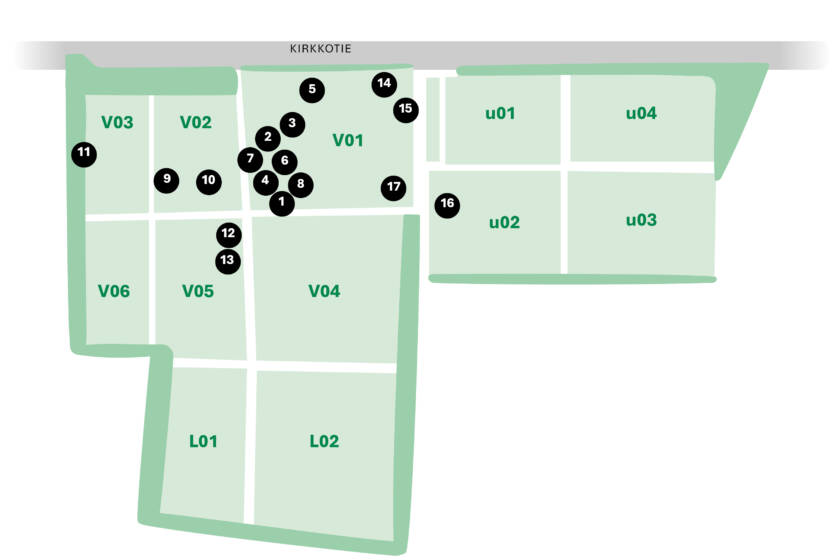
1. John G. Annala
American lawyer (b. 1881 in Peräseinäjoki, d. 1961 in Fitchburg, USA). He spent his working life in the United States. In his will, he donated a significant sum of money to his birthplace. A foundation named Annala manages the donated assets and distributes grants in accordance with the testator’s wishes.
2. Karl Johan Vartiainen (1859–1901)
The first pastor of the Peräseinäjoki parish, serving from 1894 to 1901. As a preacher, he was considered difficult to understand, but otherwise he carried out his pastoral duties impeccably.
3. Hannes Kirkkala (1883–1958)
Long-time cantor of the Peräseinäjoki parish from 1905 to 1954.
4. Vihtori Luoma (1857–1929) and Anni Luoma (1857–1935)
Vihtori Luoma and Anni Luoma were the first elementary school teachers in Peräseinäjoki. They spent their entire careers at the Viitala Elementary School, where Vihtori taught from 1892 to 1927.
5. Pietari Elfbring (1819–1893)
Pietari Elfbring served as parish clerk and sexton at the Peräseinäjoki Church from 1847 to 1893, more than 40 years. Elfbring is known for many stories, many of which relate to his physical strength.
6. Einar Anton Kytilä (1893–1967)
A long-serving municipal physician in the 1930s–1950s.
7. Heikki Alanen (1880–1961)
Heikki Alanen served as the parish bell-ringer and also as the mail carrier.
8. Juho Lampi (1865–1953)
A businessman and sawmill owner from Peräseinäjoki. He made substantial donations to the municipality of Peräseinäjoki, the parish, and charitable causes. Also buried in the family plot are his wife, Maria Lampi (1890–1992); his parents, farmer Erkki Lampi (1837–1909) and his wife, Serafia Lampi (1831–1914); and his sister, Hedvig Lampi (1862–1912).
9. Aleksanteri Saarinen (1863–1915)
The third pastor of Peräseinäjoki, serving from 1909 to 1915. Saarinen is remembered as an intelligent but stern and austere man, who nevertheless had a good-natured sense of humour beneath the surface.
10. Juhana Yrjö Akilles Vuorinen (1866–1920)
Vuorinen was the fourth pastor of Peräseinäjoki; he served in that position for only a short time, from 1918 to 1920. Vuorinen is remembered as a frail but spirited preacher.
11. Ville Ritola (1896–1982)
Ville Ritola, a multiple Olympic champion. In Paris in 1924, Ritola won gold in the 1,000-meter race, the steeplechase, the 3,000-meter race, and the team cross-country event, as well as silver in the 5,000-meter race and the individual cross-country event. In 1928 in Amsterdam, he won gold in the 5,000-meter race and silver in the 10,000-meter race.
Ritola moved to the United States as a young man and returned there even after the Olympics. He returned to Finland in 1971, when he settled in Helsinki. It was his wish to be buried in the cemetery of his hometown, Peräseinäjoki.
12. Nikolai Honkala (1891–1964)
Nikolai Honkala served as pastor of the Peräseinäjoki parish from 1939 to 1962 and as dean of the diocese from 1952 to 1963. He was a colourful personality and a man of many talents: public speaker, musician and blacksmith. Honkala was also interested in researching the Kalevala.
13. Pentti Kortesmaa (1927–1998)
Pentti Kortesmaa was a native of the parish and served as the parish cantor from 1954 to 1992. He received his diploma from the Helsinki School of Church Music at the age of 20. Kortesmaa taught music at the Peräseinäjoki Community School and held various other jobs alongside his duties as cantor.
Other areas of the cemetery
The cemetery currently in use once had a separate section for the graves of those who had left the church. They were buried in row graves in Section V4 of the old part of the cemetery. In the current cemetery, there is no distinction anymore between those belonging to other parishes and those registered in the civil registry. Since the beginning of the 1920s, there have been different kinds of areas inside the cemetery.
The cemetery currently in use once had a separate section for the graves of those who had left the church. They were buried in row graves in Section V4 of the old part of the cemetery. Today, no distinction is made between those belonging to other parishes and those registered in the civil registry. The cemetery has had various types of burial areas since at least the 1920s. Sections V1, V2, and V5 have primarily been sections for family graves. Sections V3 and V6 have had more single graves, while section V6 has been called the “children’s section,” as it was previously used primarily for the burial of children. Section V4 consists mainly of family graves, with the exception of the row graves located on the eastern edge of the area. Currently, this distinction is no longer in use.
In the new section of the cemetery, only family plots have been allocated for a period of 30 years. The cemetery also features a memorial grove and an area for scattering ashes.
Cemetery chapel
From the 1910s onward, the blessing of the grave was held in the churchyard, in a chapel located on the eastern side of what is now the heroes’ cemetery. The cemetery chapel was destroyed in the year 1932 in the great fire of the church village. The following year, a new chapel was built in the same place. This was demolished in 1975 as it was no longer needed. The chapel was small and, being unheated, very uncomfortable in the winter. Today, funeral services are generally held in the church, though sometimes they are also held at the cemetery. A space has been reserved on the southern edge of the new section of the cemetery.