
Törnävä cemetery
Ruukintie 163, 60200 Seinäjoki
Open 6:00–23:00, all day during holidays.
06 418 4267
Cemetery and Parks office, open from 8:00 to 15:00
Accessibility
- Accessible WC
- Parking space for people with reduced mobility
About the cemetery
Törnävä church and cemetery
The first church of Seinäjoki, the Törnävä church, was originally built as a gunpowder storage facility in 1827. It was designed by the major engineer Karl Rosemkampff. It was converted into a church by following the drawings of the county architect Carl Axel Setterberg between 1862 and 1864. The storage tower was raised, and the East end was converted into a sacristy. The windows were enlarged, except for the ones on the gable end, which were closed shut.
The Törnävä church is a long church, plastered and painted white. The windows and door arches reference a Gothic style; the same goes for the rafters and the decorations on the altar and pulpit.
The altarpiece “Jeesus Getsemanessa” was painted by the artist Alexandra Fosterus-Såltin in the year 1877. It is the first commissioned work of almost 70 altarpieces painted by the artist. The window paintings on the outer section are the work of Liisa Karjarinta, from Seinäjoki. The church can fit almost 550 faithful people who want to hear the word of God.
There are no archival materials regarding the establishment of the cemetery, but various sources suggest that the cemetery was built at the same time as the renovation work.
The lots for the church and the cemetery were donated by the ironmaster G. A Wasastjerna, who has large credits in the foundation of the parish. The cemetery area has been the subject of many expansions which required the acquisition of more land. Because the area is moist and boggy, it required a significant amount of work to drain and improve the soil.
The oldest surviving gravestone at the Törnävä Cemetery dates back to 1864.
The burial culture then and now
The custom of placing the cemetery right next to the church comes from the old times. Since the Middle Ages, prominent figures have occasionally been buried beneath the church, which was regarded as the most prestigious place. In 1823, burial beneath the church was prohibited by imperial decree.
A cemetery was always built around or near a church, and this was also the case in Seinäjoki. Before the chapel parish was established in 1863, residents of Seinäjoki were buried in the old cemetery in Ilmajoki and in the Nurmo cemetery.
Around a hundred years ago, in agricultural societies, the majority of the people died at home. Their loved ones washed, dressed, and laid the deceased in the coffin. On the morning of the burial, the mourners would get to the place and would say their goodbyes around the open casket. The processions to the funeral were held with a hearse or a bier. The casket was black. The white casket became more common at the start of the 1930s.
The cemetery chapel of the Seinäjoki parish was completed in the year 1908. Before that, funeral services were held at the cemetery gates. The casket was carried to the grave accompanied by the priest and the cantor chanting. After the funeral, a memorial service was held at the funeral house.
As burial services for fallen heroes started to be held in churches during the war years, the practice became more common. The funeral chapel used for these services fell into disuse and was demolished in 1962.
In the mid-20th century, the funeral home began managing all operations preceding the funeral. Nowadays, in the procession from the funeral to the gravesite, the casket is held by a hearse, with the priest and the funeral director leading the way. The memorials are usually held inside the parish.
The new chapel-crematorium was completed in 1979. Nowadays, blessing ceremonies are held in the small and large chapels, as well as at Törnävä Church. Blessing and memorial services have become increasingly private, what can be called a quiet funeral.
Since the completion of the crematorium, cremation has become more common and has opened up possibilities for various burial options. In addition to family and urn graves, urns are buried specifically in a park-like urn grove.
The cemetery during the ages
The Törnävä cemetery in Seinäjoki began to take shape in the year 1864, so we can say its history is quite recent. In every memorial, plant and design, you can witness the passage of time.
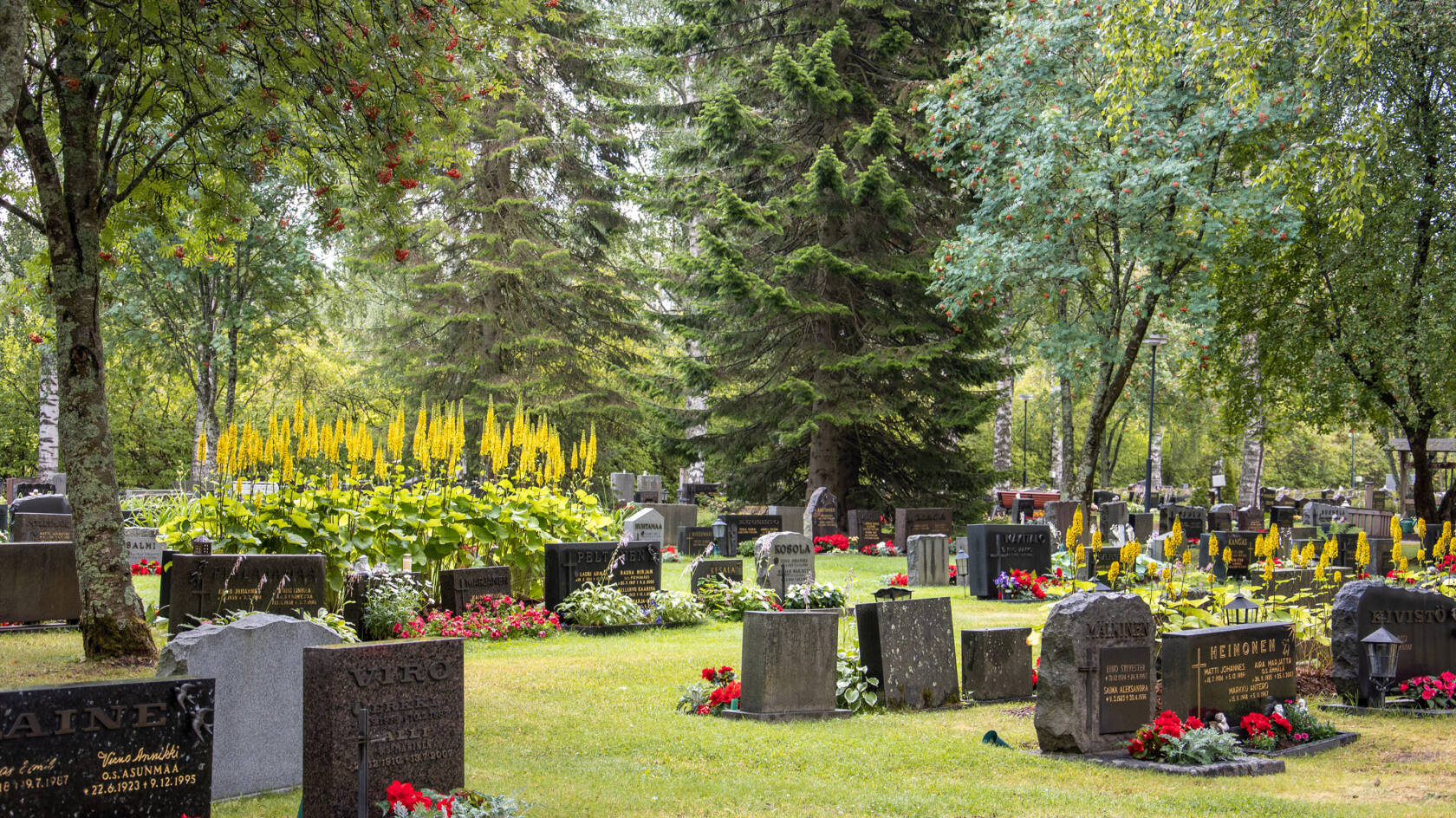
In the oldest cemetery area, the A section, the general appearance is very diverse. The memorials are usually cast-iron or wrought-iron crosses, while stone ones come in various sizes and are mainly upright. The varying sizes of family graves and memorials are also indicative of the differences in wealth and status of the families.
In the 1950s, regulations governing the size of gravestones became more common. In those years, equality was a common value. Especially in the 1960s, the trend began to show starting from the B05 section. The purpose of the regulations was to create “equal” rows of graves, whose style resembles the so-called “suitcase model.”
The new cemetery was inaugurated in 1975, and the regulations on memorials and general planning became looser.
The latest direction is the use of base beams for headstones. They are used in the new section of the cemetery. To add variety, this area introduced blocks that allow the choice of cross-shaped memorials.
Each era has left its mark on Seinäjoki Cemetery, as reflected in the “Garden of God” and its story for visitors.
Heroes’ cemetery
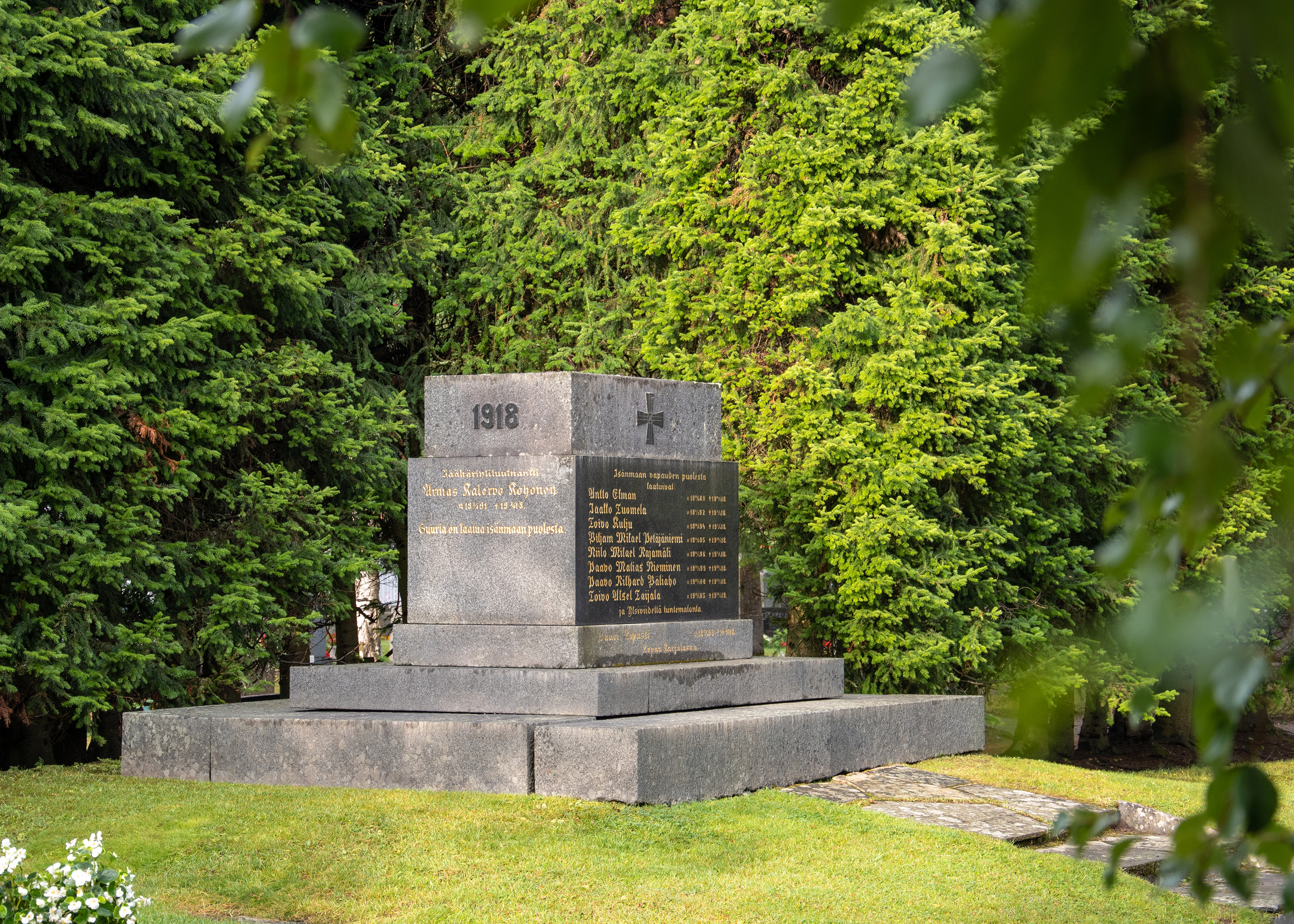
Memorials to the War of 1918
The heroes’ section of the cemetery counts a total of 166 fallen soldiers. The ones died in the Finnish Civil War of 1918 are buried in the West end area. Eight of them were from Seinäjoki. In the same area are also buried 41 unknown soldiers who were brought to Seinäjoki for identification, since that was the town where the headquarters were located.
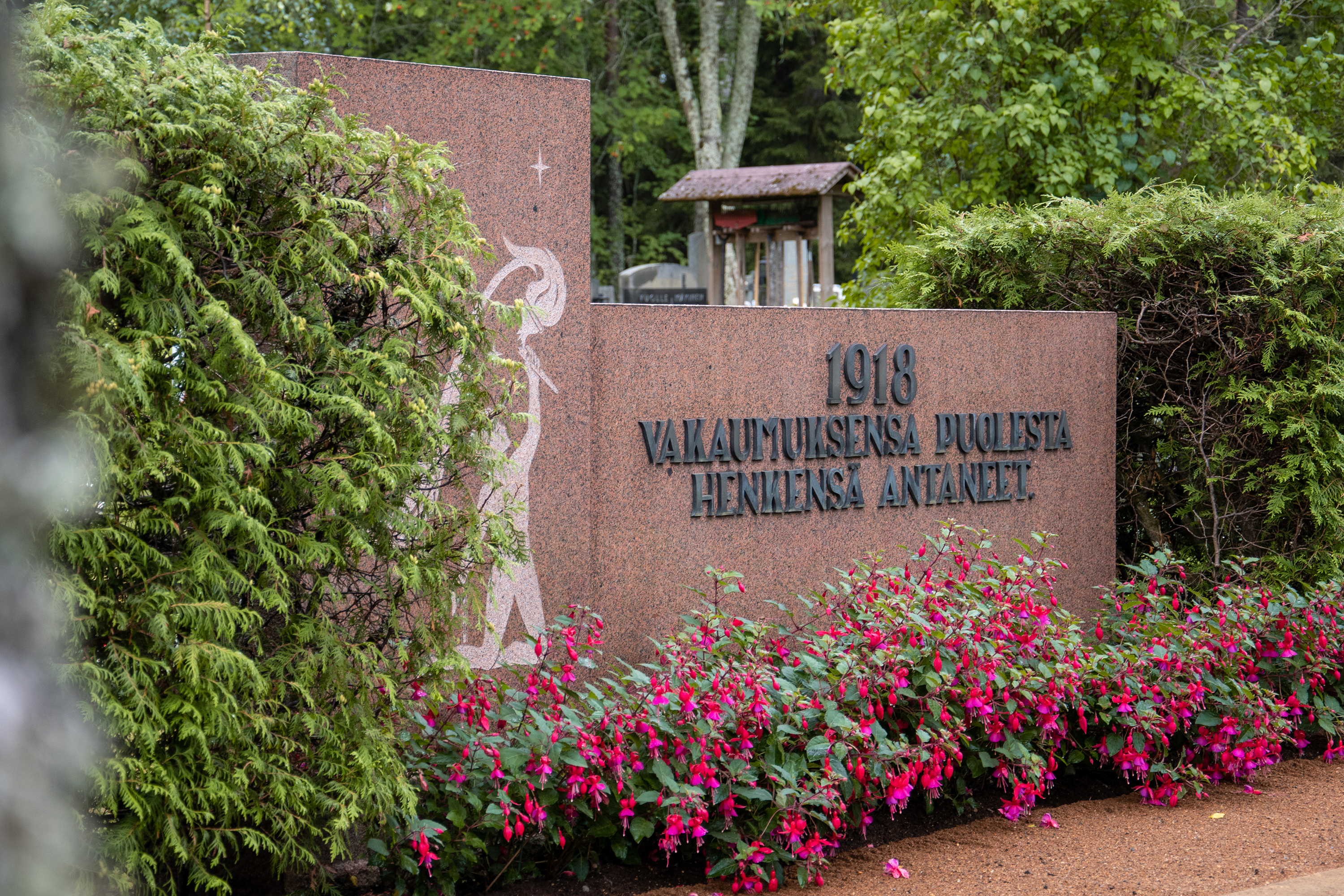
The fallen heroes of the Finnish Civil War have their own memorial. It was unveiled on the 31st of July, 1921. A memorial committee was established by the Seinäjoki Civil Guard with roasmaster Holmi (Hulmi) as its chairman. The designer of the monument is unknown, but the stone was carved at Rehn’s stone workshop in Vaasa. At the unveiling ceremony, the monument was entrusted to the care of the Seinäjoki parish.
The statue for the heroes of the Finnish Civil War is the first memorial erected in Seinäjoki honouring the war.
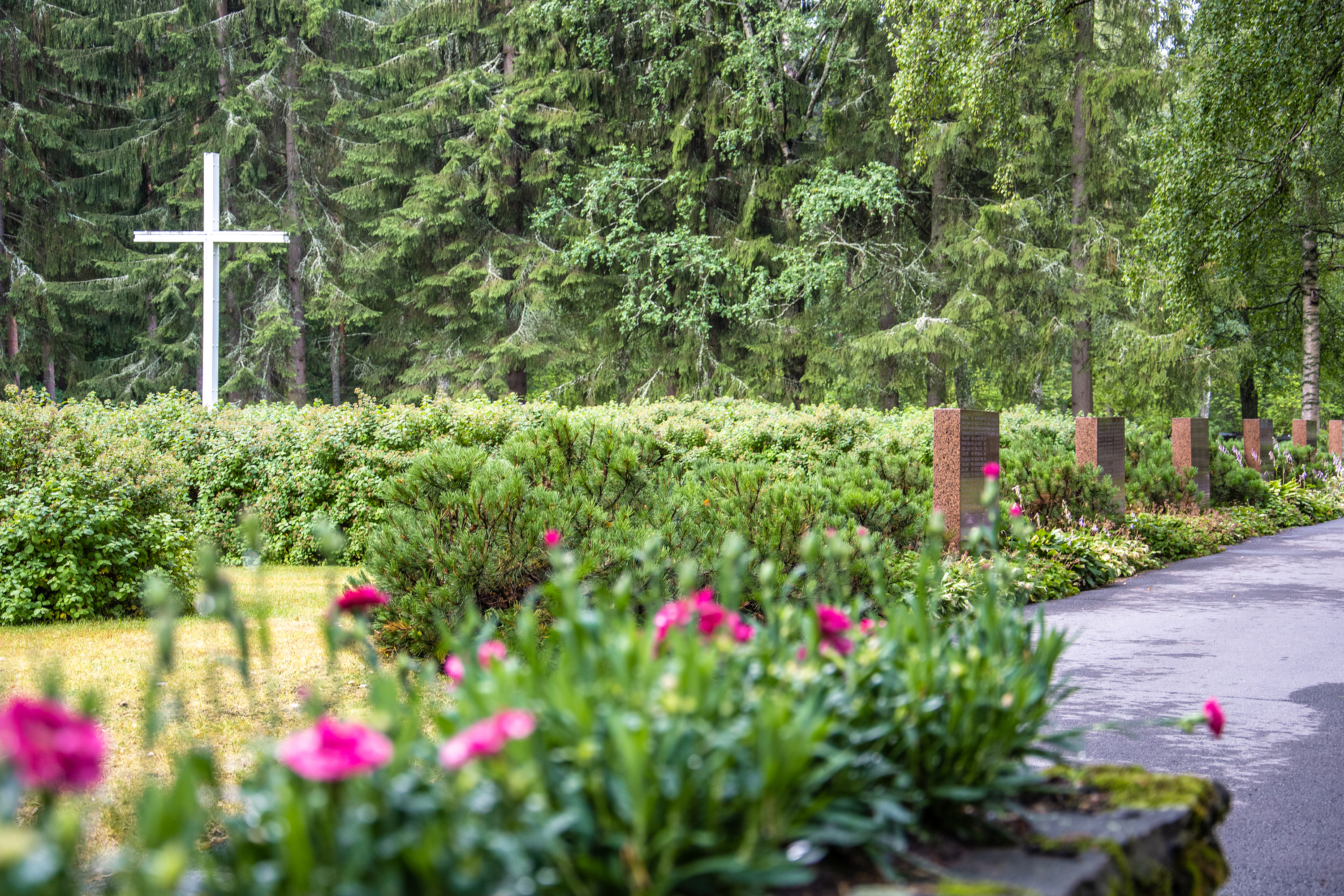
The 117 soldiers who fell during the Winter War and Continuation War of 1939–1944 are buried at the eastern end of the heroes’ cemetery. Architect Ilmari Wirkkala designed the heroes’ cemetery in 1942.
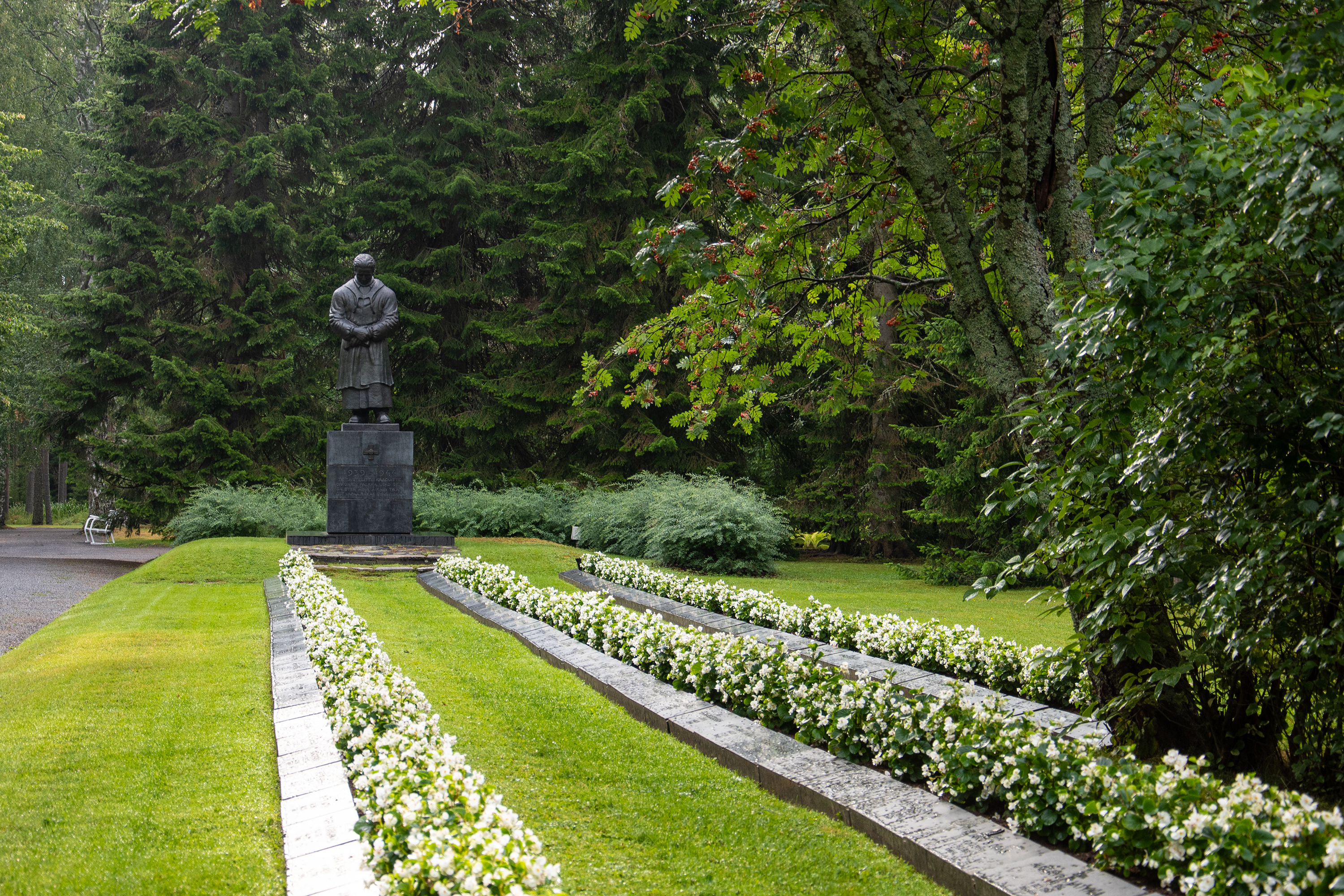
The memorials to the fallen heroes are made of matte-finished diorite. They are three slabs on top of each other, which form three long rows.
In 1944, the Seinäjoki local chapter of Lotta Svärd donated funds to the Seinäjoki parish for a statue dedicated to the fallen heroes. In 1947, the church council appointed a heroes’ statue committee, which sought funds from the parish and the town to support the project. The statue was commissioned from Oskari Jauhiainen in the year 1948. “Rukoileva sotilas” was completed in 1951 and unveiled on the 6th of July 1952.
The memorial in Section A7, dedicated to those who died for their beliefs, was unveiled on October 8, 1950. Approximately 30 soldiers executed in Seinäjoki are buried in this area, although none of them was from Seinäjoki. The memorial was designed by conductor Aarne Mäkelä.
Seinäjoki district hospital cemetery
The cemetery of the Seinäjoki District Mental Hospital was established separately from the Seinäjoki parish cemetery and was opened on June 3, 1934. The cemetery is located on the land owned by the hospital, near the parish cemetery. The hospital staff was responsible for digging the grave and carrying the casket to the cemetery. The patients were blessed at the gravesite.
Hospital patients were buried in this area primarily between 1934 and 1976. A total of 629 hospital patients and employees have been buried here.
The hospital was inaugurated on March 12, 1923. From the mid-1940s through the 1960s, the hospital had at most approximately 900 beds. The hospital municipal association counted 118 members from the former provinces of Oulu, Vaasa, Central Finland, and Häme. In 1968, the name was changed to Törnävä Hospital. Its operation as an independent hospital ended at the end of the 1990s, when it merged with the Seinäjoki Central Hospital.
The cemetery came under the parish’s care as part of a land transaction in 1971, when the Seinäjoki parish purchased land from the hospital, including the farmland needed to expand the cemetery. At the same time, the memorials, plantings, and lawn areas in the cemetery section were arranged into their current layout.
Sights and notable graves
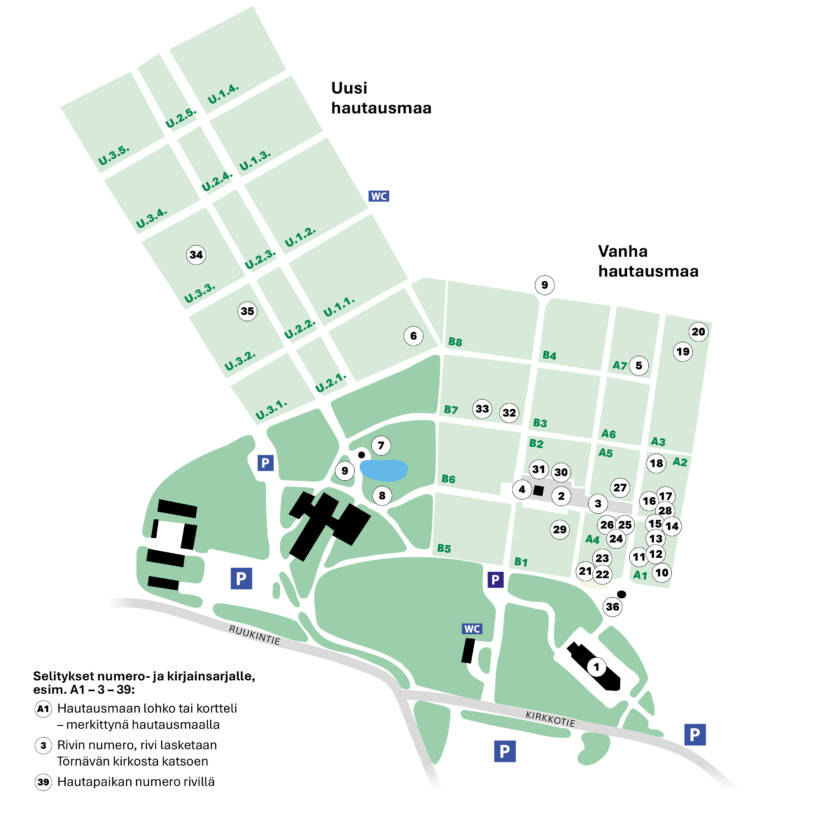
Explanations for the number and letter sequences, e.g., A1–3–39:
A1 = Cemetery plot or section – marked at the cemetery
3 = Row number. Rows are numbered starting from Törnävä Church
39 = Grave number in the row
A1–3–39 Otto Edvard Könni (1858–1931)
Otto Edvard Könni was a Member of Parliament and local councillor from Seinäjoki who was a passionate advocate for cultural and economic issues.
A1–7–75 Herman Ludvig Hellsberg (1857–1891)
Herman Ludvig Hellsberg served as chaplain in Seinäjoki from 1882 to 1891 and learnt Finnish whilst there. He wished to be buried in Seinäjoki alongside his wife and young son, even though he had moved away from the area.
A1–9–103 Gustav August Wasastjerna (1923–1905)
Gustav August Wasastjerna, an agricultural adviser and ironworks owner, played a decisive role in the establishment of the parish. The memorial was designed by the sculptor Alpo Sailo and crafted by the local stonemason Valentin Sillanpää from stone quarried at Hallilanvuori. The monument was erected in 1914 by the Seinäjoki parish and local agricultural development association. Wasastjerna also served as churchwarden for many years.
A1–12–132 Jussi Arvi Koivusalo (1929–2000)
The sculptor Jussi Arvi Koivusalo designed this gravestone for his parents, the teachers Mikko (1899–1969) and Katri (1900–1974) Koivusalo. The stone resembles a fish, which was a symbol used by Christians in the early Christian era. A “woman of the körtti” has been placed in the oval recess.
A1–12–135 Herman Björkqvist (1812–1887)
Church builder Herman Björkqvist oversaw the conversion work when the Törnävä Church was built from a gunpowder store. He also served as churchwarden for many years. The Koivusalos are descendants of Björkqvist.
A1–14–162–163 Robert Herman Tammilehto (1902–1954)
Robert Herman Tammilehto, Master of Laws, was born in Seinäjoki and served as municipal manager of the town of Seinäjoki from 1935 to 1954. He was a well-liked and upright public official.
A2–1–1 Jaakko Kustaanpoika Katila (1860–1964)
The oldest known grave in Törnävä Cemetery is that of Jaakko Kustaanpoika Katila (1860–1864), a child buried on 14 August 1864. The letters ÅJMB on the iron cross indicate its place of manufacture: Åbo Jernmanufaktur Bolag.
2–2–13 Juho Jaakko (Jussi) Tala (1904–1999)
Juho Jaakko (Jussi) Tala, a farmer and district judge, served as the parish treasurer and was enthusiastically and energetically involved in the planning and construction of Lakeuden Risti.
A2–3–30 Matti Nuolivirta (1929–)
Matti Nuolivirta, Master of Science in Engineering and City Manager, served as City Manager of Seinäjoki from 1974 to 1992, having previously held the positions of Deputy City Manager and City Engineer.
A2–14–176 Joel Spets (1847–1903)
Joel Spets, a lighthouse keeper and sharpshooter, founded the Seinäjoki Workers’ Association and bequeathed his property to it. His memorial is shaped like a cannon barrel.
A3–30–619 Aleksanteri Vikel (1881–1929)
Aleksanteri Vikel, popularly known as Vikelli, was a folk musician and a well-known player of the clarinet, locally called the klaneetti. He belonged to the Wegelius family of Seinäjoki.
A3–32–674 Konstantin Törnudd (1848–1925)
Konstantin Törnudd, a Court of Appeal Counsellor, owned the Östermyra Manor from 1904 to 1925. He renamed the manor Törnävä after his birthplace, Tyrnävä. He bequeathed the manor to the Rural Municipality of Seinäjoki, which erected a memorial in his honour. Near Törnudd’s grave, in the forest outside the cemetery fence, lies his dog Turva, whom he had wished to be buried in the same grave with him.
A4–1–10 Oiva Polari (formerly Pollari) (1912–1996)
Oiva Polari (formerly Pollari) was a visual artist from Seinäjoki and a painter of the Ostrobothnian landscape. The granite memorial was designed by the graphic artist Osmo Pasanen of Helsinki and was produced at Kuntola Stone Carving Workshop in Kurikka.
A4–1–11 Kauko Kalervo Kekki (1915–1983)
Kauko Kalervo Kekki moved to Seinäjoki from Käkisalmi after the wars and worked diligently on behalf of Karelian evacuees. In 1946, he and his wife Taimi established a flower shop in Seinäjoki. The grave is marked by a natural stone, and it also features a miniature replica of Terho Sakki’s sculpture Heimotulet, which Kekki received as a 50th birthday gift from Karelians. The original sculpture stands in the church park of Lakeuden Risti.
A4–2–18 Toivo Lauri Iisakki Knuutila (1912–2000)
Toivo Lauri Iisakki Knuutila, Rural Dean, was the third parish priest of Seinäjoki. He came to Seinäjoki as a youth pastor in 1945, served as parish priest from 1952 to 1975, and during the final years of his ministry also served as Rural Dean of the Ilmajoki Deanery. He was also a well-liked teacher of religious education at Seinäjoki Lyceum.
A4–7–83 Jaakko Oskari Itävaara (formerly Österberg)
(1887–1944)
Jaakko Oskari Itävaara (formerly Österberg) served as the parish cantor from 1925 to 1944. He was also a choir director and a music teacher at the secondary school.
A4–11–123 Israel Yritys (1887–1964)
Israel Yritys, Counsellor of Economy, was one of Seinäjoki’s most prominent industrialists. He owned a sawmill as well as the Seinäjoki Spinning and Weaving Mill, and he served energetically in various positions of trust within both the parish and the market town.
A4–11–126 Emil Oskari Ojala (1869–1960)
Emil Oskari Ojala was the second parish priest of the Parish of Seinäjoki. He served the parish for more than four decades. Ojala was a distinctive and well-liked pastor, and numerous stories about him are still told in Seinäjoki today.
A5–3–28–29 Erkki Kuparinen (1917–2016)
Provost Erkki Kuparinen was the fourth parish priest of Seinäjoki. He entered the service of the parish as an assistant pastor in 1954 and served as parish priest from 1975 to 1980.
B1–10–165 Oskari Herttua (1876–1953)
Oskari Herttua, Counsellor of Economy, served as a bank manager and as director of Itikka and Alko in Seinäjoki. He was an influential figure in municipal affairs and contributed to the development of secondary education in Seinäjoki.
B2–2–26–27 Walter Lounatvuori (formerly Lemberg) (1894–1965)
Walter Lounatvuori (formerly Lemberg) founded Pohjois-Suomen Sähkö Oy and was a pioneer in his field. The company is still in operation, and ownership has now passed to the third generation.
B2–2–31 Olavi Piha (1911–1995)
Olavi Piha, Counsellor of the City and Master of Laws, was born in Seinäjoki and served as municipal manager of the market town of Seinäjoki from 1955 to 1959 and as City Manager from 1960 to 1974.
B7–2–46 Lauri Koivisto (1893–1978)
Lauri Koivisto, Counsellor of Commerce, owned a car dealership. He was a pioneer and developer of the automotive industry in Ostrobothnia. He played a decisive role in the establishment of the Seinäjoki School of Business. He was also involved in initiating entrepreneurial association activities.
B7–9–200 Ellen Alakanto (1918–1971)
Ellen Alakanto, a textile artist, designed and produced textiles for many public spaces in Seinäjoki. The church textiles of Lakeuden Risti were designed by Alvar Aalto and made by Alakanto. Her gravestone is a natural stone featuring a sculpture by Jussi Koivusalo, which had been displayed in the artist’s private home and was later treated by Koivusalo to withstand changing weather conditions.
U3.2–12–147 Jussi Iisakki Salo (1928–1989)
Provost Jussi Iisakki Salo served the Parish of Seinäjoki as an assistant pastor from 1966 to 1980 and as parish priest from 1980 to 1989. The gravestone comes from his home forest in Nurmo. The portrait reliefs of Jussi Salo and his wife Terttu were created by their daughter-in-law Tuula Salo. The reliefs were cast by Tiina Laasanen and Pauli Venäläinen / Venäläinen Art Foundry.
U3.3–6–236 Lauri (Lasse) Lintala (1935–2009)
Lauri (Lasse) Lintala, Counsellor of Music, was a versatile music influencer and choir director who had a significant impact on the founding of, among other initiatives, the Ilmajoki Music Festival and the Seinäjoki Tango Festival.
Urn Grove
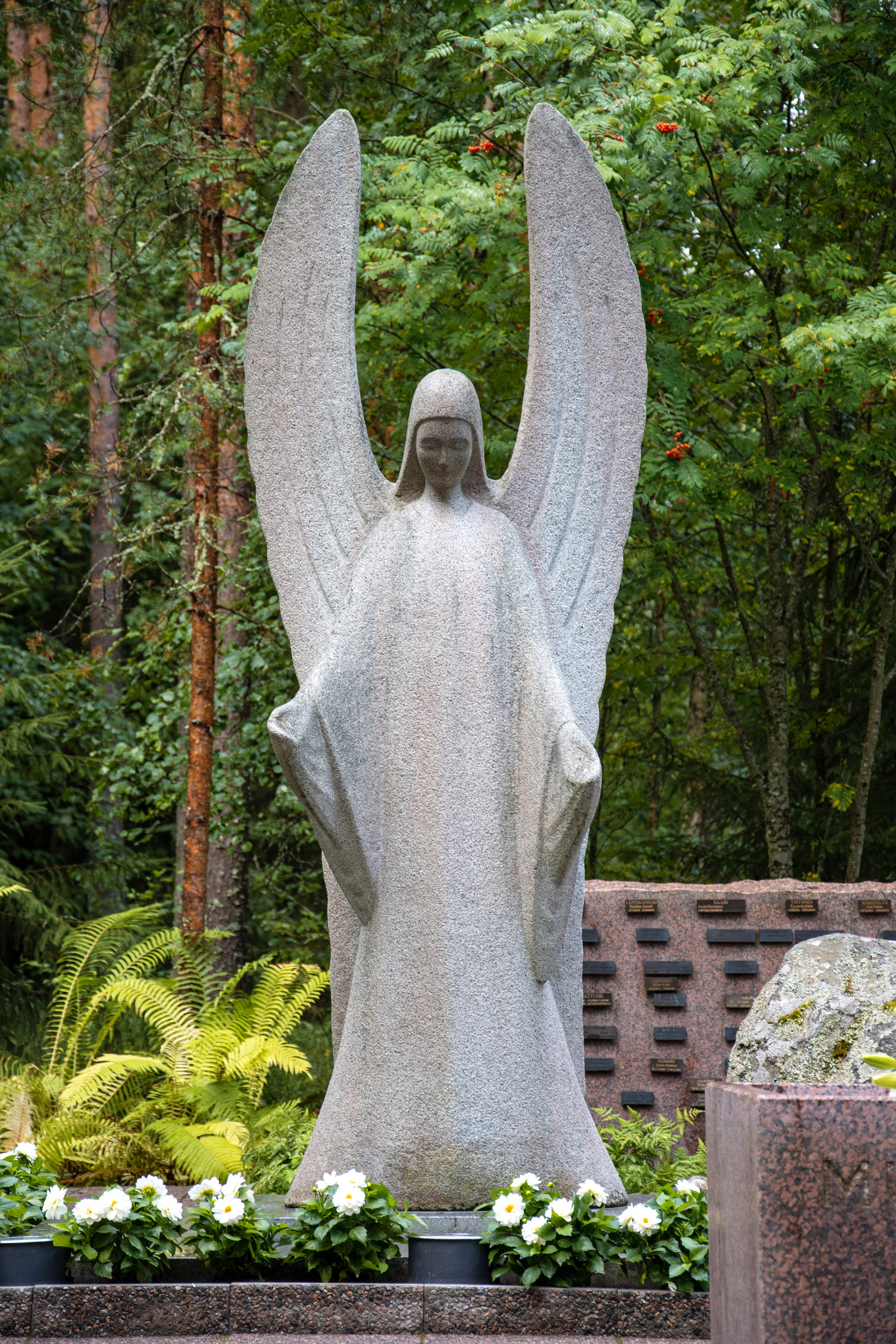
The Urn Grove of the Seinäjoki parish was consecrated on 19 August 1984 as part of the 120th anniversary celebrations of Törnävä Church. The concept for the form of the sculpture and the overall design of the memorial area was created by Eero Virtaniemi, a horticulturist who served as the parish gardener.
The sculpture was created by the artist Eelis Räsänen at the stone carving workshop of Mustakivi Oy in Viitasaari. The 2.5-metre-high angel statue is made of grey granite from Kuru. Name plaques for those buried in the Urn Grove are attached to a stone wall made of red granite from Taivassalo.
The Urn Grove is situated in the wooded area surrounding the funeral chapels of the Seinäjoki parish. The upward-reaching angel, the stone wall symbolising a rock tomb, and the “rolling stone” can be found in the forest. The Easter morning events are then symbolically represented in a Finnish setting. The angel on the grave announces: “He has risen.” The Urn Grove complex gets its name from this message.
After the funeral service, floral tributes for those to be buried in the Urn Grove are placed at the angel statue. The area contains numbered burial plots. After cremation, the ashes are interred in the Urn Grove either with or without an urn.
The parish is responsible for the flower plantings and all other maintenance of the area.
Memorial Pillars
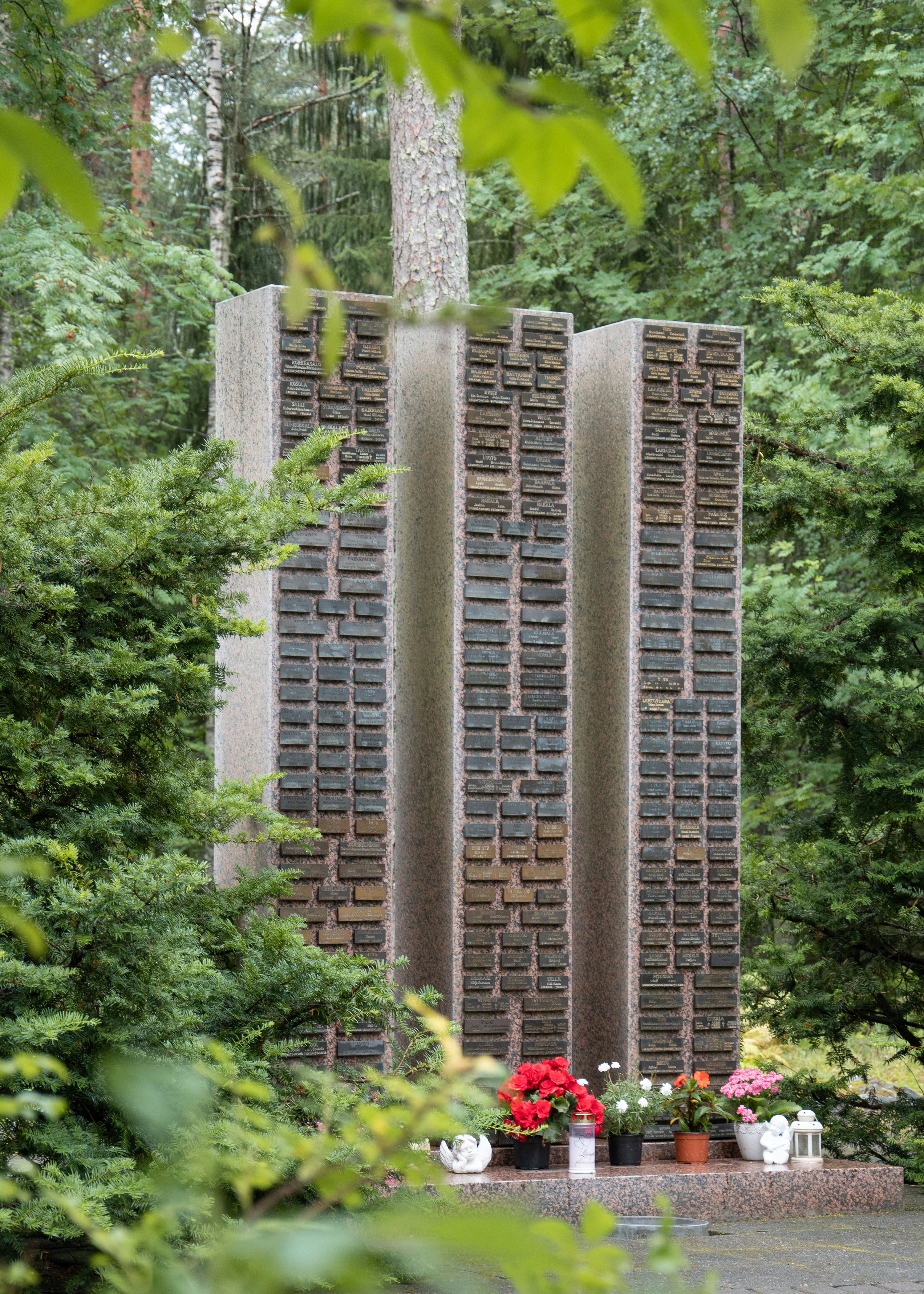
The memorial pillars were erected in August 1994. They were designed by Eero Virtaniemi, a horticulturist who served as the parish gardener from 1964 to 1994. The pillars are made of red granite.
Relatives may choose to hand over to the parish their old burial plots or family graves. This option is often considered when family members have moved away from the locality. The relatives may sign a written deed to cede the grave to the parish. Upon handover, the parish transfers the information from the gravestone to a metal plaque, which will be fitted to the colonnade, in accordance with the agreement. The memorial is then removed from the relinquished grave. The name plates make it possible for the deceased to continue to be remembered in the cemetery even when the relatives are no longer responsible for maintaining the family grave. Now that the original pillars are full, the memorial pillar area was relocated to the vicinity of the funeral chapel and the urn grove.
The memorial pillars provide a place where visitors may join in silence or light a candle in memory of those who have passed away.
Empty Arms memorial
This thought-provoking memorial was created at the initiative of the Midwives’ Association of Vaasa Province in cooperation with the Parish of Seinäjoki for those who are childless and for parents who have lost a child. The memorial was unveiled on 24 October 2009.
 https://seinajoenseurakunta.fi/wp-content/uploads/sites/7/2026/03/tornavan_hautausmaa8_sarah_senf.jpg
 https://seinajoenseurakunta.fi/wp-content/uploads/sites/7/2026/03/tornavan_hautausmaa_sarah_senf.jpg
 https://seinajoenseurakunta.fi/wp-content/uploads/sites/7/2026/03/tornavan_hautausmaa4_sarah_senf.jpg
 https://seinajoenseurakunta.fi/wp-content/uploads/sites/7/2026/03/tornavan_hautausmaa7_sarah_senf.jpg
 https://seinajoenseurakunta.fi/wp-content/uploads/sites/7/2026/03/tornavan_hautausmaa2_sarah_senf.jpg
 https://seinajoenseurakunta.fi/wp-content/uploads/sites/7/2026/03/tornavan_hautausmaa5_sarah_senf.jpg